Restoring 1M context in Claude Desktop's Cowork mode
Code: github.com/evanjcosgrove/claude-cowork-1m-patch
If you’re here to use the patch rather than read the reverse-engineering writeup, start with the README runbook. The operator instructions live there: enable Full Disk Access for the terminal app running the script, then relaunch Claude with osascript -e 'quit app "Claude"'; sleep 3; open -a Claude after patching.
The regression
Two Cowork sessions, ninety minutes apart, same Claude Desktop install. The 18:36 session had a 1M-token context window. The 19:59 session had 200K. Nothing on my end had changed.
I checked the logs. The earlier session’s spawn line ended in --model claude-opus-4-6[1m]. The later one ended in --model claude-opus-4-6 - same model name, no [1m] suffix. Same app version (1.569.0). Same Max plan. Same device, same everything.
Whatever had changed wasn’t on my end. It lived on the server, and it flipped sometime between 18:36 and 19:59 on March 19, 2026.
What follows is what it took to find that flag, get past the four integrity layers Electron and macOS wrap around a signed app, and put back the context window I’d been paying for.
Cowork is Claude Desktop’s local-agent mode - a sandboxed VM that runs Claude with a stack of business and knowledge-work plugins (product, sales, marketing, data, productivity) and direct access to the tools they wrap (Slack, Notion, [insert X SaaS here…]). The 1M-token context window is one of the main paid features, and the reason I’d been running multi-hour sessions that pulled from half a dozen of those tools at once. Dropping to 200K means losing the ability to hold a whole project - call notes, dashboards, exported chats, source documents - in working memory at the same time. I reached out to Anthropic support multiple times only to receive canned responses, filed an issue, found 16 others doing the same across #36760, #36351, and #33154, and watched each of them sit untouched for 30+ days.
Show the Anthropic Support thread
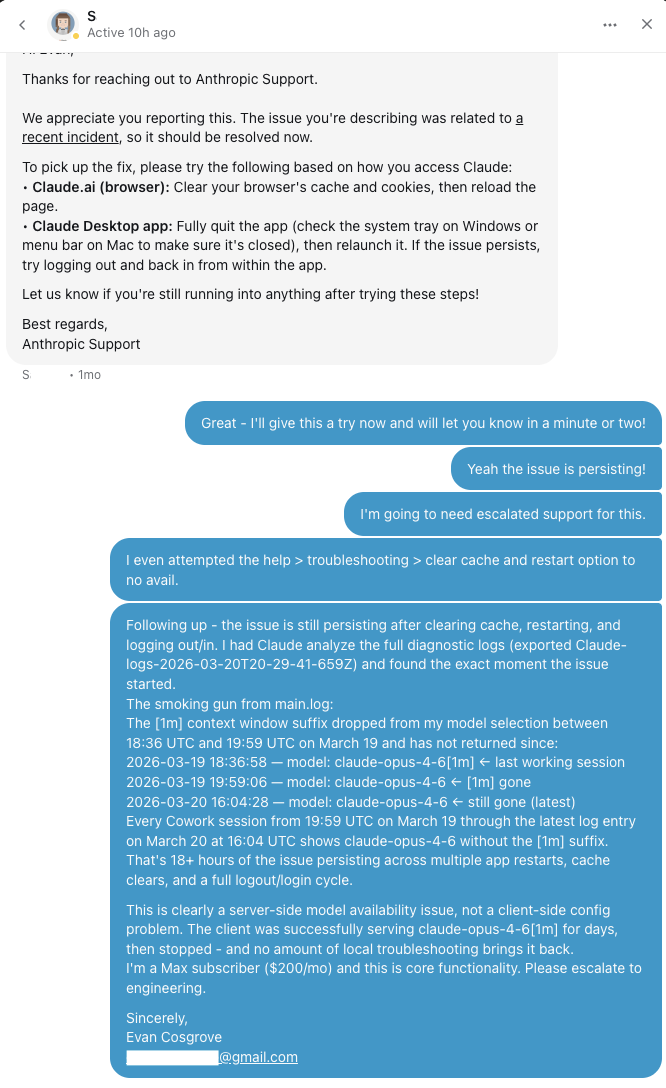
So I went looking for a solution myself.
My first guess was that something on the client side was passing the wrong model identifier. Claude Code CLI reads ANTHROPIC_DEFAULT_OPUS_MODEL from the environment to pick which model to invoke, respecting ~/.claude/settings.json by default. Cowork, on the other hand, couldn’t care less. The model picker in the Desktop UI listed Opus 4.6 (no longer showcasing the 1M tag); and running /context proved that the spawn arguments lacked the [1m] suffix.
That ruled out the easy fixes. Whatever was deciding the model identifier in Cowork wasn’t reading the same environment variable the CLI did. The model resolution was happening somewhere inside Claude Desktop’s renderer process, between the user’s click and the spawn.
That meant looking at the binary.
Inside the binary
I extracted the asar with npx @electron/asar extract /Applications/Claude.app/Contents/Resources/app.asar /tmp/claude-extracted. The minified renderer code lives in .vite/build/index.js - about 11 MB of JavaScript with everything mangled to single and double-letter names.
I started by grepping for [1m], the suffix that was supposed to get appended. Found it inside one function:
function ZAt(t) {
  return /\[1m\]/i.test(t) || !Sn("3885610113") || !/sonnet-4-6|opus-4-6/i.test(t)
    ? t : `${t}[1m]`
}
Three conditions joined by OR. If any of them is true, the function returns the model name unchanged. If all three are false, it appends [1m].
Walking through them: the first condition skips anything that already has [1m] (idempotency). The second is a server feature-flag check - Sn("3885610113") returns whether flag 3885610113 is on for this client, and the leading ! flips it. The third is a model-name allow-list - only sonnet-4-6 and opus-4-6 qualify for the suffix.
The middle condition was the regression. When the flag was on, !Sn(...) evaluated to false and the function fell through to the suffix. When the flag was off, !Sn(...) evaluated to true and the suffix was never appended. The flag had been on as of 18:36 on March 19, off as of 19:59. Same binary, different server state.
The function name ZAt is minified - it changes between Claude Desktop builds. The flag ID 3885610113 is the only stable string in the area. Any patch had to anchor on the flag ID, not the function name.
The same-length swap
The obvious thing to try first was: extract the asar, edit the JavaScript, repack. I’d already extracted, so I just modified the function - replaced the Sn("...") call with false - and ran npx @electron/asar pack /tmp/claude-extracted /tmp/app.asar.patched.
The repacked archive came out at 60 MB. The original was 19 MB. Something was off.
The cause turned out to be benign-looking: the extract command pulls files from app.asar.unpacked into the extraction directory alongside the actual asar contents - native .node binaries that Electron deliberately keeps outside the archive. When pack repacked, it pulled those binaries back in. Three times the size.
I copied the inflated asar into place anyway and launched Claude Desktop. Got an EXC_BREAKPOINT (SIGTRAP) crash 224 ms after launch, with the top of the stack trace pointing at node::sea::SeaResource::use_code_cache().
That sentence took me a while to understand. V8 caches compiled JavaScript bytecode against the asar’s file offsets. When the asar’s size or layout changes, every offset shifts; the bytecode cache thinks it’s pointing at function f and is actually pointing at the middle of a string literal, and V8 hits the trap immediately on first invocation. (See docs/root-cause-analysis.md for the longer version.)
I had assumed extracting and repacking would work. I was wrong. The extract/repack approach wasn’t viable on a freshly-launched binary with a cached bytecode store, regardless of whether the JavaScript inside was correct.
I needed to modify the bytes in place, without changing any offsets.
The constraint was: any byte I changed had to be replaced by exactly the same number of bytes. Then no offsets would shift, and V8’s bytecode cache would still point at valid code.
The original expression was 17 bytes:
!Sn("3885610113")
I needed a same-length JavaScript expression that evaluated to false. The shortest is !1 - two bytes. That left fifteen bytes to fill with something the JavaScript parser would ignore.
JavaScript block comments are syntactically valid in expression positions and the comment body can be anything. Block comment delimiters cost four bytes (/* and */). Eleven characters of padding fit between them:
!1/*___________*/
Two bytes for !1, four bytes for the comment delimiters, eleven underscores in the middle. Seventeen bytes total. The expression evaluates to false. The function falls through to the [1m] suffix.
The substitution itself is a raw byte replacement - no JavaScript parsing involved, no AST manipulation, just read → str_replace → write against the asar file. The Python that does it asserts the new payload is exactly the same length as the old one before writing, and asserts the unique-occurrence count of the anchor (one match, no more) before replacing. If either invariant fails, the script aborts before touching the binary.
The same trick generalizes: find a stable byte anchor for the flag identifier, swap the surrounding expression for a same-length literal that evaluates to the value you want, leave everything else alone.
The four-layer integrity wall
After the same-length swap, I copied the patched asar into place and launched. Got an immediate error in the Console:
ASAR Integrity Violation: hash mismatch
The asar header - the JSON that lists every file in the archive with its offset, size, and SHA256 hash - had been left untouched. The JavaScript content had changed - same total length, different bytes - so the per-file SHA256 in the header no longer matched the actual content.
I extracted the header with @electron/asar’s getRawHeader(), parsed it, and recomputed the SHA256 for .vite/build/index.js from the new file content. For files larger than 4 MB, the integrity record stores both a top-level hash and per-block hashes (one per 4 MB chunk). The .vite/build/index.js is 11 MB, so three block hashes plus the top-level hash. All four had to be recomputed. Then in-place byte-replacement again - old hex string for new hex string, both 64 characters, no offset shift. Launch.
Different error, same shape:
ElectronAsarIntegrity hash mismatch (Resources/app.asar)
Layer 3. The asar’s header SHA256 is itself stored in Info.plist under the ElectronAsarIntegrity key, so even if you’ve updated all the per-file hashes inside the header, the header itself has changed and the plist’s record of it is now stale. plutil -replace ElectronAsarIntegrity.Resources/app\.asar.hash -string "<new hash>" Info.plist and re-launch.
That layer pattern - try it, fail, read the error, identify the next integrity check, recompute, replace - was the whole work of the next two hours. Modern signed-app integrity isn’t a single check; it’s a cascade. Electron documents the asar-integrity mechanism - per-file hashes inside the header, header hash inside Info.plist. The macOS code-signing layer below it, and specifically the --entitlements interaction, isn’t in their docs at all. It’s the same general architecture that the Trail of Bits ASAR integrity bypass exploited a year ago against Signal, 1Password, and Slack (CVE-2025-55305) and that an earlier bug bypassed at the header level (CVE-2024-46992). (Electron’s advisory for CVE-2024-46992 is scoped to Windows under specific fuse configurations - I’m citing it for the same general integrity-layer pattern, not claiming Claude Desktop on macOS was affected by that specific CVE.) The layers each do their job; you have to peel them in order. (Per-layer reference: docs/integrity-layers.md.)
Three integrity layers passed; Claude Desktop launched. But Cowork itself wouldn’t start. The session-start animation rolled, then a modal: “Invalid installation - Claude’s installation appears to be corrupted.”
I attached lldb to the swift VM helper and traced the message back to a single call:
require("@ant/claude-swift").vm.isVirtualizationSupported()
which was returning "entitlement_missing". The com.apple.security.virtualization entitlement, which Cowork’s local VM sandbox needs, was missing from the code signature.
The cause was an earlier codesign --force --deep --sign - invocation. The --deep flag re-signs every framework inside the app bundle, and that re-signing strips entitlements that aren’t in the per-framework Info.plist. Anthropic’s own signature on the inner frameworks had carried the virtualization entitlement; mine didn’t, because I hadn’t passed an entitlements plist.
The fix had to happen in a specific order. Extract Anthropic’s entitlements before any binary modification, with codesign -d --entitlements - /Applications/Claude.app > entitlements.plist. Modify the binary. Re-sign with codesign --force --sign - --entitlements entitlements.plist /Applications/Claude.app - without --deep, so the inner frameworks keep their original signatures.
It worked.
![Claude Desktop v1.3109.0 showing claude-opus-4-7[1m] with 55.2k / 1m tokens in the /context view](img/verification.png)
Same Cowork session, next spawn after the patch, and the [1m] suffix came back. /context confirmed it: model resolution was quietly appending the suffix again.
I packaged the work into a single bash script that handles the whole sequence - extract entitlements, back up, byte-swap the JavaScript, recompute the per-file and header hashes, re-sign with the preserved entitlements. The same session has continued without interruption since. I’ve been using it for about a month before deciding to write any of this up, hoping that Anthropic would fix the regression before I had to.
What I learned
Three things from this:
- Server-side feature flags inside client binaries that gate paid functionality create a class of regression that normal QA misses. From the QA perspective, the binary works - flag-on, flag-off, both behaviors are intentional. Nothing tests the wrong-default-for-this-customer case. Clients should observe their own flag state and surface it somewhere a user can find it; otherwise paying customers carry the ambiguity and the support burden.
- V8’s bytecode cache is the single most under-discussed constraint in Electron app modification. Every blog post about asar patching I read while debugging this either omitted the bytecode-cache problem or hand-waved it. The
EXC_BREAKPOINT224 ms in is the exact failure mode the same-length-swap technique exists to prevent. Anyone modifying a signed Electron app on a desktop platform will hit this; documenting it more loudly seems worth doing. - Modern signed-app integrity is multi-layered and well-designed. Bypassing it required understanding all four layers in order: JavaScript application logic, per-file SHA256 hashes inside the asar header, the asar header’s own SHA256 hash inside
Info.plist, and the macOS code signature with its entitlement records. Skipping any one layer broke the next launch. Whoever built this thought through the threat model.
Since this writeup, two more regressions have landed. On April 18, opus-4-7 shipped to Cowork and broke a second JS gate in the same function - a model-allow-list I’d glossed over because the original regex already matched what I needed. On April 20, v1.3109 refactored that gate from a regex literal into a JS array. Different syntax, same three OR conditions, same flag ID, same [1m] template. The byte-anchor approach holds because the strings it pins on - the flag ID, the model names - are the stable parts. Expect the surrounding syntax to keep rotating; each iteration is tracked in CHANGELOG.md and docs/root-cause-analysis.md.
Further Reading
- README - install, scope, compatibility, rollback
- CHANGELOG - what changed when, by Claude Desktop version
- docs/integrity-layers.md - the four integrity layers in detail
- docs/root-cause-analysis.md - how the flag was found, why extract/repack fails
- Discussions - Q&A, version-compat chatter, bug-report template